Meet Five Women Carving Their Own Paths
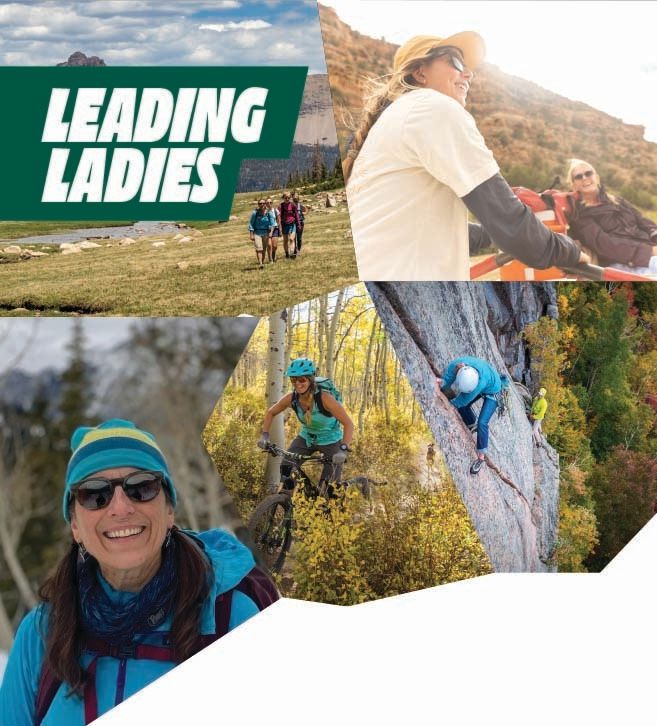
In the mountains, a great guide does more than lead the way—they teach, encourage, and help people realize a potential they didn’t know they had. Yet even as women now make up half of all outdoor participants, they remain underrepresented in guiding, especially in its more technical disciplines. That gap is slowly narrowing, thanks to women who are expanding what leadership in the outdoors looks like. Here we introduce you to five exceptional local guides doing just that, each in her own way.

Shaun Deutschlander
Founder, owner, and lead guide of Inspired Summit Adventures; AMGA- certified ski guide and AIARE avalanche educator
On an alarmingly warm March afternoon, Shaun Deutschlander and I had a conversation that had become a grim refrain throughout the West: how hot, dry, and short the winter had been. The ski resorts’ seasons were cut short both at the start and the end, and most of the state’s guide companies had barely eked out two months of guiding on snow.
However, thanks to the years Deutschlander had dedicated to securing permits to access hundreds of thousands of acres in the Uinta Mountain Range, the 2025–26 season was not nearly as bad as it could have been for her guiding company, Inspired Summit Adventures (ISA). “We have access to so much terrain, so we were able to find fresh tracks pretty much every time we went out, even after weeks of high pressure,” she says.
I spent four days in the Western Uintas, backcountry skiing with Deutschlander in March 2025—alternating untracked powder runs with sauna sessions, tasty meals, and plenty of laughs at the cozy backcountry yurts she owns through ISA. Her fish-in-water comfort in the Uintas made me assume she was born and raised in the mountains. But Shaun grew up just outside of New York City in suburban Westchester County, an environment she never felt at home in. As a child, she regularly escaped to the 100-acre nature preserve that backed up to her childhood home, spending hours getting to know “every plant, rock, and drop of water.”
“In our family, as soon as you could walk, you learned how to ski,” she says. Each winter, her family would travel to either Colorado or Utah for ski trips, and it was during one of these trips that Deutschlander’s mother observed her gazing out the window at the mountains, listening to John Denver on her Walkman, with tears rolling down her cheeks. “From then on, she called me ‘the West waiting to happen,’” recalls Deutschlander.
Despite being firmly entrenched in their East Coast lifestyle, Deutschlander’s parents acknowledged what their children “were and were not,” she says. And so when it came time for college, Deutschlander had their full support in bypassing the Ivy-clad universities her prep school classmates were choosing for the University of Colorado at Boulder. “And just like that, I was surrounded by people who loved nature as much as I did and had a canvas on which to express that,” says Deutschlander.
After earning her degree, Deutschlander moved to Park City for her first guiding gig: taking 17-year-olds backpacking and rafting for the Norwegian Outdoor Exploration Center. A few years later, while working in White Pine Touring’s retail store, she got to know the educators who taught the shop’s avalanche classes, “And I realized that’s what I wanted to be.”
Within a few seasons, she joined the ranks of White Pine’s avalanche educators while guiding snowcat skiing in the Uintas for Park City Powder Cats. In 2012, Deutschlander decided it was time to go out on her own and founded ISA to create experiences that “meet our clients where they are and help them reach far beyond their perceived boundaries,” she says. “I love helping people have those aha moments when they learn, apply, and succeed.” Along the way, Deutschlander married her best friend, Weston, and became a mom to her now 9-year-old daughter, River.
As she’s aged, Deutschlander has noticed more women considering her as a mentor. “And I’m leaning into that,” she says. “I’m also seeing more requests for women-specific programming, which I’m happy to offer. Because it’s just more fun.”

Emilie Drinkwater
Guide for Exum Mountain Guides, Powderbird heli-skiing, and American Mountain Guide Association national instructor team member
“I got my first real guiding job because I am a woman,” Emilie Drinkwater recalls. “I remember the guide service owner saying that they were starting to see more women clients and had more requests for female guides. That got me in the door. I never really thought about being the only woman guide then, though I think about it more now. When I was starting, I was so determined to be a guide that if there was interest from climbers who wanted a female guide, I wanted to be there for the opportunity.”
Drinkwater was raised in New Hampshire and attended St. Lawrence University, a small liberal arts college located within a stone’s throw of the Adirondack Mountains. There she competed as an NCAA Nordic skier and learned to rock climb during the summers. “After graduation, I really wanted to just climb but had a lot of student debt to pay off, so I got a job at a summer camp teaching kids to canoe and rock climb,” she says. The rest of the year, she waited tables and did landscaping—anything to make climbing happen during the summer. Within a few years, she transitioned from camp instruction to guiding adults, eventually adding ice climbing and backcountry skiing to her guiding inventory while juggling winter jobs.
Like many guides, Drinkwater jumped into the profession with no formal training. But then, after doing it for several years, “I realized that if I wanted to be a career guide, I needed and wanted a formal education,” she says. She began taking courses through the American Mountain Guides Association (AMGA). “With each subsequent course I took, I was learning a lot and becoming a better guide. I also understood that educating myself was the key to guiding outside of the Adirondacks.”
Since then, Drinkwater became the ninth American woman to complete the International Federation of Mountain Guides Associations (IFMGA) certification, a rigorous and globally recognized guiding credential, considered the pinnacle of the guiding profession, requiring completion of rock, ski, and ice climbing programs. She’s guided clients up and down mountains throughout the world, including a 2018 climb alongside Hanifa Yousoufi, the first Afghan woman to summit Afghanistan’s highest peak, Mount Noshaq (24,580 feet). Now, Drinkwater works primarily in Utah for Powderbird in the winter and travels globally to guide her clients the rest of the year. In the space between, she helps other guides hone their craft as an AMGA instructor and examiner.
For all the achievements she’s amassed, Drinkwater says what really fills her cup is returning to the mountains with someone year after year, nurturing their skills and confidence, and watching them grow into a competent outdoorsperson. This summer, she will go to Colorado with a longtime client to climb the Diamond, the sheer east face of Longs Peak in Rocky Mountain National Park.
Over the 25 years she’s spent as a professional mountain guide, Drinkwater has observed subtle dynamics shaping women in the mountains. “I think there’s an idea in people’s minds that a woman is going to be more conservative, or more cautious. And I think that’s mostly just an idea,” she says. “I also think women are good at reading the room, or tuning into where the people around them are at, and responding to that.”

Julie Faure
CEO, co-owner, and guide, Utah Mountain Adventures
Though she was raised in Paris, France, Julie Faure has been immersed in mountain life almost from birth. “My father and his family were climbers and skiers, and were way into their mountains, which made me love the mountains too,” Faure says. She fondly remembers her family squeezing into the one-bedroom, second-floor chalet apartment her grandfather rented near the Villars-sur-Ollon ski resort, where they’d ski in the winter and hike in the summer. “My sister and I slept in the closet,” she says. “That time spent there made it our place.” In her teens, Faure began going into the mountains on her own to climb at Fontainebleau, a bouldering area outside of Paris, and to mountaineer in Chamonix.
After high school, Faure was determined to make her own way in America and chose to attend the University of Pennsylvania to study geology. Field schools introduced her to the West, and during a climbing trip to Wyoming, she thought, “This is where I belong.” Faure spent a couple of years working as a geologist in Denver after earning her undergraduate degree, until her boyfriend at the time suggested they spend a season skiing in Utah at Alta. “We got jobs at the Alta Lodge and skied and rock climbed every day,” she says.
After learning about guiding opportunities in Wyoming, Faure remained in Little Cottonwood Canyon for the winter but dedicated her summers to guiding for Exum Mountain Guides on the Grand Teton. “Once I had a guest tell me that I was worth more than his shrink,” she recalls. “I believed in him and his ability to climb a difficult objective, and I promised him that I hadn’t brought him there that far if I didn’t think he could do it. The confidence a person can gain from climbing with a good guide is pretty amazing.”
In 1993, a group of now locally famous mountain guides—Kitty Calhoun, Ian Wade, Peter Lev, and Ted Wilson—founded a franchise of Exum Mountain Guides in Utah, now known as Utah Mountain Adventures (UMA). Faure began ski guiding for the fledgling Utah guide service in the 1993–94 season, and by 1996 was UMA president and director. “All of the founders had other jobs, and so they asked me to run it,” she says. “In those early days, we didn’t make any money, so they paid me in shares of the company. Eventually, I just bought them out of what remained.”
In between guiding in the Tetons and in Utah, Faure has climbed, skied, and adventured throughout the world. She completed the first ski descent of Mount Foraker’s Sultana Ridge in Denali National Park, and summited 23,000-foot Khan Tengri in Kyrgyzstan’s Tien Shan Mountain Range. She has enjoyed many nights on Yosemite’s big walls and in the Black Canyon of the Gunnison, and she rode a bicycle through Western China, Tibet, and Vietnam. She also met and married her husband and business partner, Tyson Bradley, and raised two now-adult boys.
Faure doesn’t recall a time when she wasn’t surrounded by women in the mountains. But she has observed how much women have to gain from spending time outside. “Women find it difficult to leave stuff behind, but doing things like rock climbing gives them this unique feeling of accomplishment, of getting out there and doing something hard,” she says. “And then the confidence you feel after doing it is very close to heroism. Giving that feeling to others is why I became a guide.”

Jacqueline Pollard
Lead guide, Holiday River Expeditions
Deep within Canyonlands National Park, the Colorado and Green Rivers come together at Cataract Canyon, a 14-mile stretch of river peppered with more than 30 rapids that challenge even the most seasoned river runners. Just before the confluence, a sign on the riverbank warns passersby of the big water ahead. “It is no joke,” Jacqueline Pollard says. “The water in Cataract can run at a rate that produces ocean-size waves.”
As she’s done for the last 10 years, Pollard is spending this summer navigating multiple Southern Utah rivers, including Cataract Canyon, via oar raft, giving guests from around the world a taste of the magic only a multiday river trip can provide. “I love how river trips make people vulnerable,” she says. “It takes people out of their element, and you get to learn much more about them than you would in a situation that’s more familiar or comfortable.”
Pollard was born in Salt Lake City but spent most of her early days in Little Cottonwood Canyon attending the Alta School, a one-room school located in the Goldminer’s Daughter Lodge. “We’d go to school in our PJs, and then when school got out at 3 o’clock, all we had to do was slip on our snow clothes to ski until the lifts closed at 4:30,” she recalls.
For college, Pollard chose to stay near her beloved Little Cottonwood Canyon and enrolled at Westminster University. Then, at age 19, inspired by her brother, who’d guided rivers in Montana for several seasons, Pollard decided to give river guiding in Southern Utah a go.
Like all aspiring Holiday River Expeditions guides, Pollard spent her first summer working in the outfit’s Green River warehouse, helping guides pack and prep for trips before they headed out, and cleaning gear when they returned. “I’m grateful for that time. It teaches you the whole picture of what it takes to get a trip out on the river and how important support people are to the success of a trip,” she says.
Her first summer on the oars, Pollard mostly ran Desolation Canyon, a relatively moderate stretch of the Green River where one Class III rapid (intermediate-level whitewater), called Cow Swim, is as technical as it gets. “But Deso is considered one of the most challenging to guide because of how long it is, 86 miles, much of which is flat water. And Holiday does not use motors. Our owner, Tim Gaylord, likes to say, ‘your guide is your two-stroke,’” she says with a wry smile.
Pollard is now a lead guide for all itineraries Holiday offers, including Cataract Canyon (Class III–V), a trip she says is becoming even more challenging as the waters in Lake Powell recede due to drought. “Rapids that were previously submerged by the lake are showing themselves again, like this one called Gypsum, toward what is now the end of the canyon, that is known for giving rafters a hard time,” she says.
During her decade guiding rivers, Pollard has noticed subtle differences in the way men and women approach the job: “If you take a first-year woman and a first-year man, the man may do a little better that first year because they generally rely more on muscling their way through rapids. But by year three, the man and woman are likely to be equally as good, or maybe the woman is even a little better, because from the start she had to rely more heavily on reading the water and finessing her way through rapids versus being able to fall back on strength alone.”
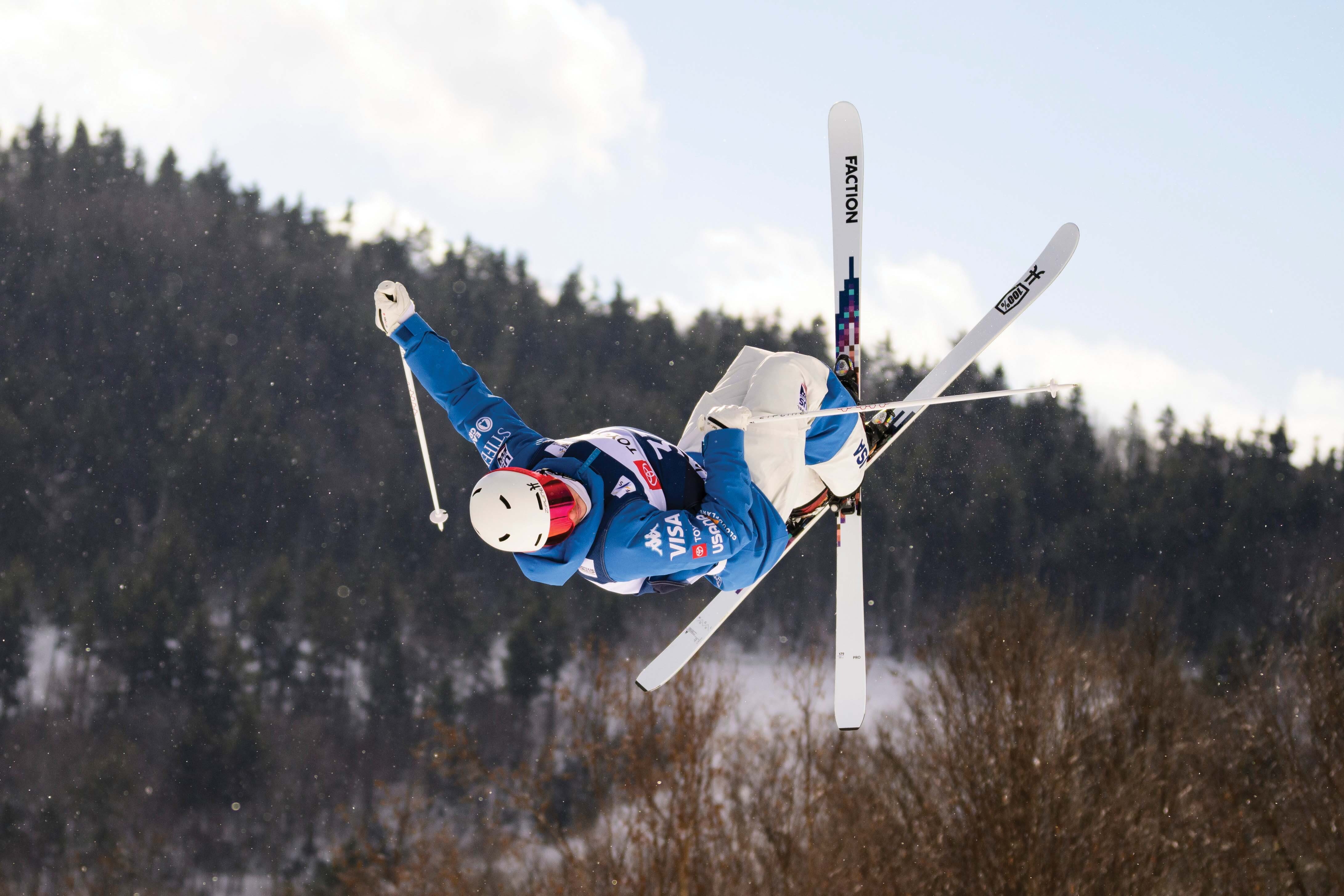
Pollard doesn’t limit her leadership skills to river guiding. After several years of competing on the Freeride World Tour (FWT)—during which SKI magazine described her as “one of the best big mountain professional skiers on the planet”—her winters are spent traveling overseas as an FWT judge and coaching teen skiers on Little Cottonwood Canyon’s Alta-Bird Freeride Team.
“Being a guide has really grown my love for the outdoors, and has deepened my appreciation of how important it is for mental health,” she says. “Going outside and seeing canyon walls that have taken thousands of years to form just puts everything into perspective.”

Julie Salmi
All-seasons guide, White Pine Touring
“I would call the kind of guiding I do lifestyle guiding. We go out, have an adventure, maybe the clients get to learn a few things, and then the sandwich they have after we get back tastes better than any sandwich they’ve ever had,” says Julie Salmi, a wide grin spreading across her face.
Though she was born in Arizona and moved with her family to Park City when she was in middle school, Salmi considered Utah home long before then. “A good friend of my dad’s, John Westman, who is the namesake for Lucky John Drive, convinced my parents to get a condo here before I was born,” she says. “So, I spent a lot of vacations and summers in Park City before we moved here.”
Salmi spent much of those childhood summers on her mountain bike, exploring Park City’s then-developing singletrack network. In high school, she expanded her recreational repertoire to rock climbing. “My friends, Ben and Lucas, said they wanted to learn how to rock climb, and so we went about it in a very non-educational way, getting away with a lot of stuff before we all got mentors,” she says.
By her own admission, Salmi was a little directionless after graduating from high school, “But I knew I wanted to ride my bike and ski.” She was also intrigued with river guiding and hit the road for Moab, where she landed a job guiding river trips on the Colorado and Green Rivers. “I was really excited about learning how to run rivers and read the water, but by the time the summer was over, I decided it wasn’t for me,” she explains. “I missed rock climbing and mountain biking too much.”
Salmi returned to Park City and began working in restaurants. Within a few years, she met her husband, Craig, and together they owned and operated restaurants in New Mexico and Alaska, flip-flopping between those two states and their Park City home base. After eventually returning to Park City for good, the couple launched a project that would occupy most of their time off for the next decade: developing rock climbing routes on Hayden Peak, one of the most prominent monoliths in the Western Uinta Mountain Range.
“We climbed, cleaned (removing loose rock from climbing routes), and dangled in space every day off we had, in all kinds of weather,” she recalls. When the project was all said and done, the couple and Salmi’s brother, Eric, had put up more than 50 routes spanning 100-plus pitches, developing what is now one of the Uintas’ most visited climbing areas or crags. “I know a lot of people go there now, which is great to see,” Salmi says.
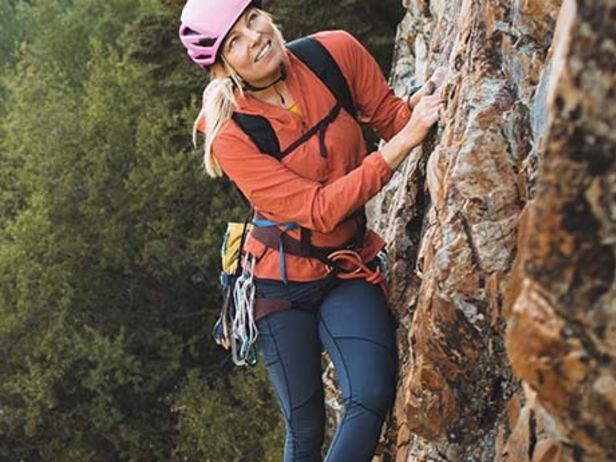
About 10 years ago, at the same time Salmi was winding down her restaurant career, Park City’s local gear shop and guide service, White Pine Touring, had acquired an expanded permit for the Uintas. “They approached me about working as a climbing guide for them,” Salmi says. Because White Pine also offers guided mountain biking, she got to do that too. “I couldn’t believe I was finally able to get to do these two things as a job,” she says.
Now Salmi guides multiple activities year-round for White Pine, from mountain biking and rock climbing to cross-country skiing and hiking. When asked what she’s gained from guiding, Salmi is quick to answer: “I have this amazing friend group made up of other guides and people in the outdoor industry—a level of camaraderie I never had when I worked in restaurants. I also really love sharing the things I love to do with people who visit here. Seeing people have fun biking or climbing really lights me up. I think spending time outdoors is great for our mental and physical health. I also think the world definitely needs more play.”