Meet Four Hometown Olympic Hopefuls

Image: Courtesy Waterville Moguls
Bumping into an Olympian or Paralympian in Park City isn’t unusual. They’re everywhere. As host to past and future Winter Olympic Games, the promise, culture, and infrastructure for nurturing elite winter sports athletes have become tightly woven into the fabric of this legacy-savvy ski town.
Last go-round, 50-plus local athletes represented Park City on Team USA (and a smattering of other national teams) in Beijing. This February and March, once again, a robust posse hailing from Park City Nation is on track to compete on the world’s stage. As we look ahead to the slopes, tracks, courses, jumps, and ice sheets of northern Italy, here are four local athletes to watch as they approach their first (fingers crossed) Olympic and Paralympic Games. Let’s go, PC! Or, as the Italians say, forza!
Editor’s note: As of press time, Team USA rosters were not yet named for the 2026 Olympic Winter Games. Along with these prospective first-timers, freeskier and three-time X Games medalist Rell Harwood and freestyle aerialist and 2025 World Champion Quinn Dehlinger are also looking at imminent Olympic berths.

Image: andy earl
Dylan Marcellini
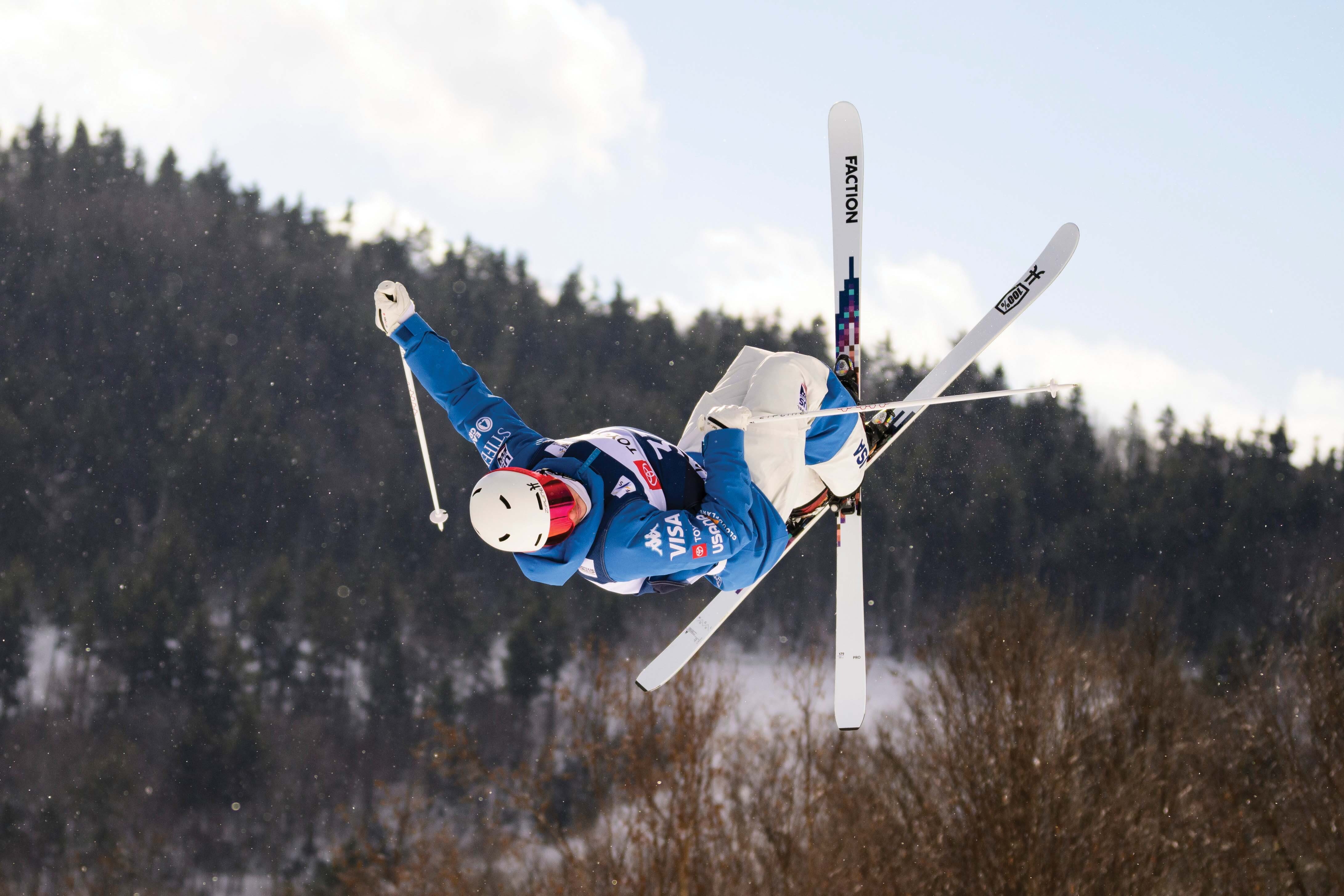
Last season, the pressure was on for freestyle mogul skier Dylan Marcellini. While he’d made some significant noise the prior season—including a 2024 World Cup bronze at Deer Valley—“the consistency factor” was missing. So, he took a step back from the World Cup circuit, returning to the NorAm tour where he needed sustained, top-notch results.
“After finally making it to the World Cup level, it’s tough to come back down,” he recalls. “It was a reality check for me, but it ended up working out for me really well.”
Marcellini not only won the 2024–25 NorAm tour, he also swept the US Nationals. Ever since, he’s continued to grind, packing his days with on- and off-snow training, workouts in the gym, cardio stints on his bike, and developing his mental game via “incredible resources” at the national team’s Center of Excellence.
“I push myself every day,” he says. “Just knowing that if I can be just one percent better, I’ll be prepared when those moments come.”
A California native who moved to Park City to attend the Winter Sports School, the now 23-year-old doesn’t take his opportunities for granted. He draws motivation “every single day” from his dad, who had a stroke in 2017 (and founded, owns, and runs Western Construction, where Dylan works in the offseason).
“A lot of families would probably have to give up on their kid’s dreams if something like that happened, but my parents never did. It wasn’t even a thought to them. They’ve always been behind me.”
Gratitude and grit—both physical and mental—seem to be the secret sauce in Marcellini’s ability to navigate bumps both on and off the hill. As the Olympics approach, the pressure is back. As is Marcellini.
Marcellini’s PC Picks & Tidbits
Go-to local spot: The Bagel Den
Pre-comp ritual: No rituals; just doing everything the same way, whether it’s the warm-up routine or the number of training runs before each comp.
Family pet: An Australian shepherd named Harley
Local club prior to the national team: Wasatch Freestyle
Thoughts on Olympics berth: “If I can get myself into the top four guys being named to the Olympic team, that would be incredible. It’s a lifelong dream of mine.”
Interests beyond skiing: Fishing, camping, dirt biking (though he tries to keep himself off it these days), and road biking. He’s currently taking University of Utah classes and plans to join his dad’s construction business in the future.
No. 1 fans: Mom and dad. Plus, hometown fans in Walnut Creek, California.
Misconception about freestyle moguls: In dual moguls, the first person to cross the finish line doesn’t necessarily win.

Image: andy earl
Saylor O’Brien
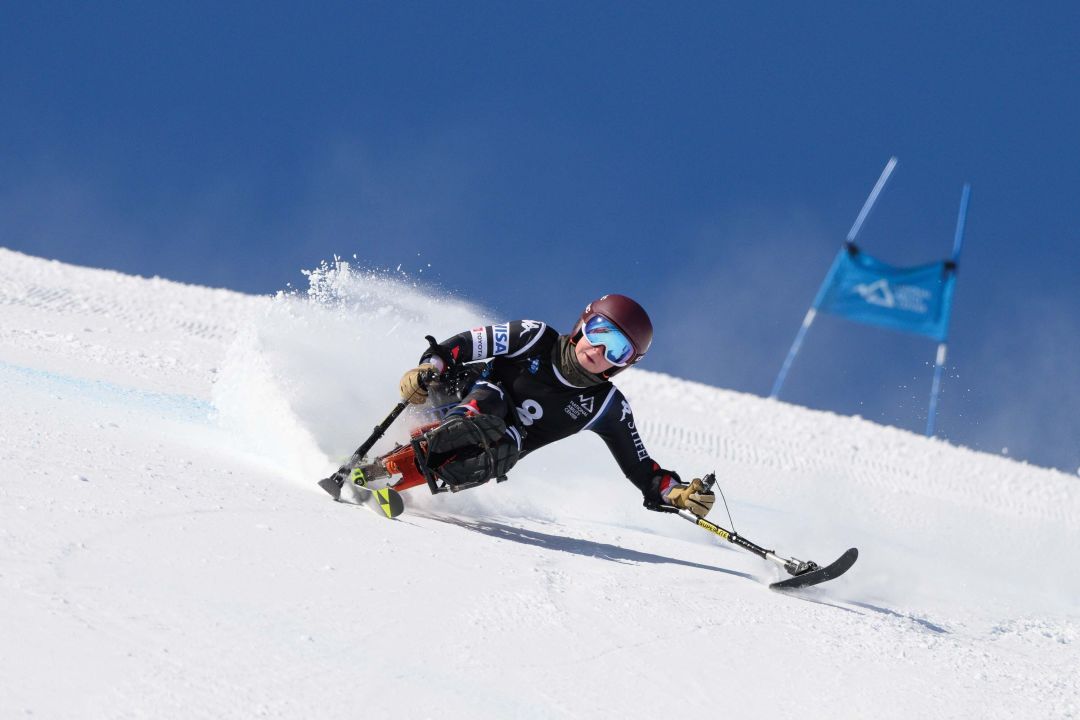
Donning her signature “war paint” (akin to baseball eye black, but colorful) and ready to “kick ass,” para-Alpine skier Saylor O’Brien heads into the Olympic year with remarkable momentum. Fresh off four World Cup podiums (including a win), a 2025 National Championship title, and being named one of US Ski & Snowboard’s Athletes of the Year, the 22-year-old has no plans to slow down.
“Not to be arrogant, but I want to be one of the greats,” she says. “I want to raise the bar even higher. I want to work even harder than everyone else. I want to show up better—whether that’s just as a human being and/or as an athlete. That’s what keeps me going.”
Born with spina bifida, O’Brien first hit the slopes at age 4. By 8, she was shredding black diamonds. At 12, she set her sights on the Paralympics, making the National Ability Center’s (NAC) High Performance Competitive Team as a four-tracker or stand-skier (using outriggers instead of poles). Given the Paralympic classification of her disability, O’Brien then had to spend 18 months learning how to sit-ski and made the NAC’s team a second time. Four years ago, she landed on the US Ski Team, won a pair of bronze medals at World Championships, podiumed at two World Cups, and qualified for the 2022 Paralympics (in which she chose not to participate, since it didn’t “align with her career at that time”). She still trains with the NAC—which she calls an “amazing community”—when at home in Park City.
O’Brien fell in love with skiing in part because of the “sense of acceptance” she felt on the slopes. No shame. No one telling her she shouldn’t or couldn’t. “I was just doing me. I was just skiing, and so was everybody else.”
While there have been ups and downs along the way, including a bout of depression in the wake of her successful 2024–25 season, the all-around skier has the potential to medal in speed as well as Alpine combined events at the Games.
“All I would ask of myself is simply to do my best—and push it,” she says. “As long as I have done my absolute best, whatever happens happens.”
O’Brien’s PC Picks & Tidbits
Go-to local spot: Atticus for a chai latte
Pre-comp rituals: Always wears a music or band T-shirt under her speed suit, and is a big fan of eyeliner and colorful “war paint” (a.k.a. liquid eye shadow on her cheeks). She listens to all kinds of music while waiting to race or train.
Family pet: Bernedoodle and best friend, Juno
Fun tidbit: She is exploring a parallel career as a budding tattoo artist.
Interests beyond skiing: Tattoo artistry and acrylic painting
No. 1 fans: “My family are my biggest fans.”
Misconception about para-Alpine: “There’s this idea that the Paralympics is a ‘less-than’ version of the Olympics or that because it has people with disabilities, we must have it easier, or it’s easier to do, or we don’t work as hard. That’s so untrue. In Paralympics, the ‘para’ portion stands for parallel to or equal to the Olympics. We need to have more conversations around the Paralympics and increase its visibility. That’s something I’m passionate about.”

Image: andy earl
Lauren Macuga
Hot off a rippin’ 2024–25 season, downhill’s fun-loving Lauren Macuga comes into this Olympic year with serious momentum. As upbeat and colorful as her bucket hat collection (45 and counting), the 23-year-old ski racer got her first taste of speed via Youth Winter Sports Alliance (now called Youth Sports Alliance) programs back in elementary school. When she qualified and won NASTAR Nationals in 2013, the racing bug officially took hold. After breaking her leg on the first run of her international debut at the Youth Olympics in Lausanne, Switzerland (and waiting out the COVID hiatus), she flew out of the international gates with gusto, hard-charging the downhill, super G, and slalom circuits and landing on top-tier podiums—most recently, winning the World Cup in St. Anton, Austria.
Topping out at 135 kmh (83.9 mph), Macuga skis with “a tense, but flowy balance,” holding steady through the bumpy, icy, steep turns but finding that flow navigating the changing terrain. Strength is key, and this lightning bolt is known for putting in her time in the gym. However, she attributes much of her success and staying power in such a demanding sport to the positive mindset instilled in her by her earliest coaches and supportive family.
“I am lucky. I was always told, ‘As long as you’re having fun, that’s all that matters,’” she says. Those early coaches helped her spin any negative thoughts on her performance into positive lessons. A bad turn, for example, became an opportunity to make that turn better. “It’s a mentally tough sport and it’s draining when you’re out there in a spandex suit and it’s negative 20 degrees and you’re thinking, ‘Why am I doing this?’ And then, I say, ‘Oh no, I get to be out here in negative 20 degrees, doing something I love.’”
Macuga’s PC Picks & Tidbits
Go-to local spots: The Bagel Den, Five5eeds, Shabu
Pre-comp ritual: Always wears Americana-style red, white, and blue socks; does the same warm-up; listens to music at the start with “Kickstart my Heart” (Great White version) as the last song.
Family pets: A husky named Yuki and a rescue dog named Bowser (a.k.a. “Nuzzles Special”). Macuga’s own tuxedo cat named Kodiak, whose photo dons her traveling blanket, as well as three additional felines: Bibble, Sprite, and Rocket.
Fun tidbit: Macuga is joined on the US National Team by two of her three siblings: Sam, a Nordic jumper, and Alli, a freestyle mogul skier. Her youngest brother, Daniel, is a ski racer like Lauren.
Thoughts on Olympics berth: “The idea of representing the USA is so cool. I want to go to the Olympics and put my best skiing forward and say, ‘This is me, this is everything I’ve got and what I’ve been working so hard for.’”
Interests beyond skiing: Reading (fantasy), water skiing, wake surfing, and mountain biking

Image: courtesy Troy Podmilsak
Troy Podmilsak
Big air and slopestyle star Troy Podmilsak doesn’t just go big, he goes huge. The 21-year-old Parkite made the US Ski Team at 15, won two Junior World Champs at 17, took down World Championships at 18—stomping a groundbreaking, triple cork 2160—and scored gold at the 2024 X Games at 19.
His motivation is simple: winning. “I really want to be the best and just win everything,” he says. “I couldn’t tell you why I want to win so badly or what gets me up to do that. That’s just it.”
Becoming top dog in freeski requires mastery of both big air and slopestyle. While “TPod” has had significant success on both sides of the equation, he prefers big air. “To me, that’s the more exciting event, and I think I’m just better at big air,” he says. “I like going big and doing the biggest, hardest trick I can do in one jump.”
Podmilsak landed in the Wasatch Mountains at age four, when his family moved to Park City from Virginia. He joined Axis Freeride alongside his big brother for a stint, and even dabbled in racing at age 8. “I cried every single day I went to that racing school,” he recalls. “That was definitely when I knew that I wanted to hit big jumps.”
Freeskiers launch roughly 50 feet in the air and travel 70 to 140 feet while performing technically precise tricks. According to Podmilsak, the experience of standing atop massive, elite competition jumps is “gut-wrenching.” As jaw-dropping and “terrifying” as it may be, big air is also a calculated sport. So, Podmilsak is greeting the Olympic year with a focused plan for every jump size (which differs by venue), deciding which gravity-defying feat could land him atop the podium.
“Calculating the size of the jumps and what tricks are possible is pretty much half of the game,” he says. While he’s hesitant to reveal exactly what new tricks may be up his sleeve, Podmilsak continues to chase boundary-pushing feats. “There are some 23s [2340s] I want to do—and cork 25s may be in the future.” For those sitting on the sidelines, as of press time, no freeskier had landed a 2520 in competition, one of the most technical and complex tricks in the sport that involves three off-axis flips while simultaneously completing seven full horizontal spins before landing.
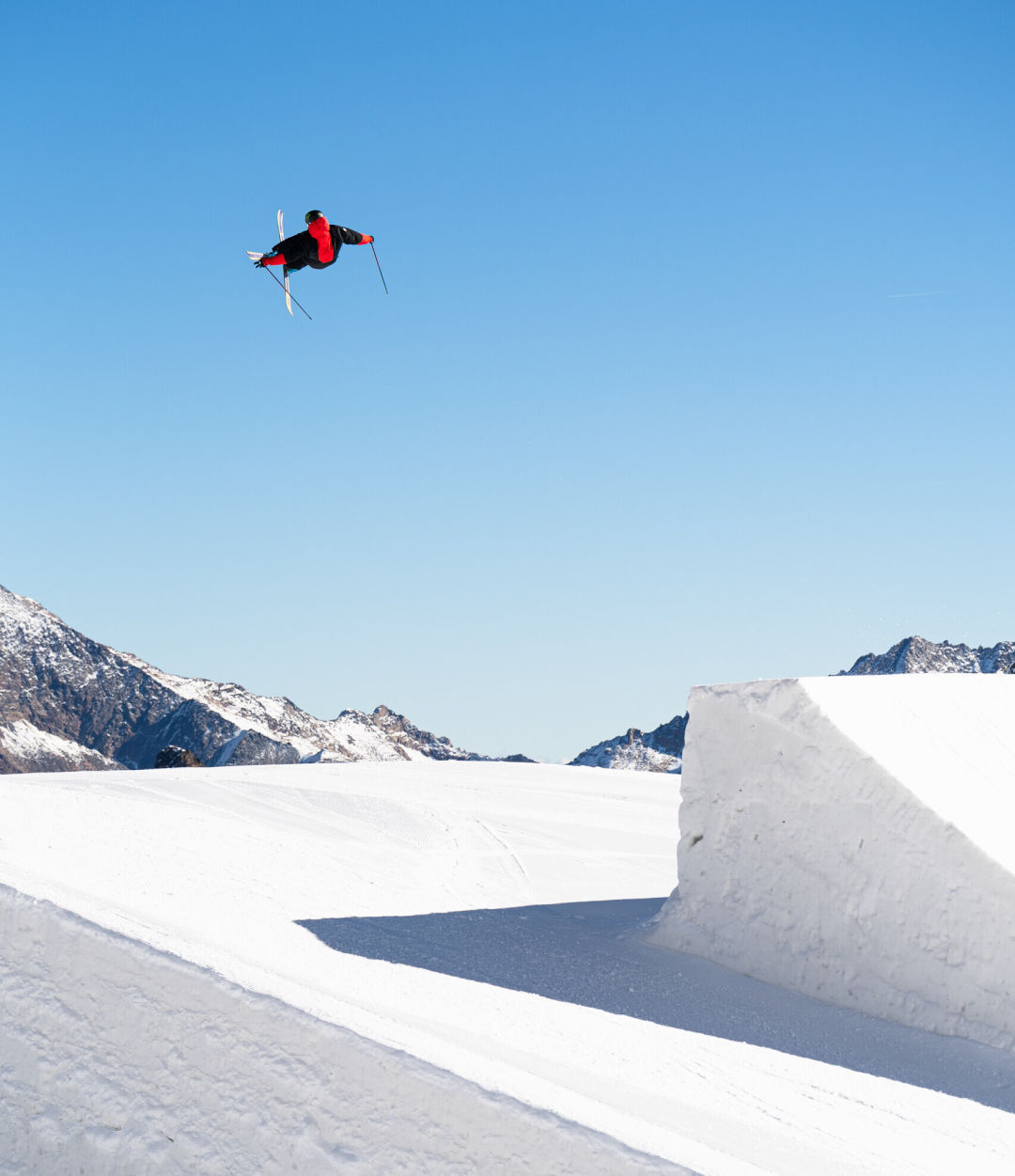
Image: Frederik Kalbermatten
Podmilsak PC Picks & Tidbits
Go-to local spots: Atticus and Davanza’s
Favorite stops on the competition circuit: X Games Aspen, “our Superbowl;” internationally, Silvaplana, Switzerland.
Pre-comp ritual: He used to drink raw eggs on contest days, but abandoned that ritual. “I guess I just go up and do my thing.”
Family pets: Lucky the dog; Freddy, Ricky, and Roxy the cats.
Fun tidbit: He recently starred in the Teton Gravity Research film, Pressure Drop.
Local club prior to the National Team: Axis Freeride
Interests beyond skiing: Golf
No. 1 fans: “My No. 1 has to be my dad. I think he loves what I do more than I love what I do. Obviously, my mom, too. They’ve really got my back.”
Misconception/layperson tips about freeski: “For slopestyle, you have to spin in all four directions. So, left, right, switch right, switch left. Slopestyle is more of a flow. It’s called slope-style, so style is a big part of it. When you’re watching a run, the more spins and the more flips you do matter, but it really comes down to who makes it look better.”